There is a peculiar quality to the anxiety that AI now produces in the people who work closest with it. It is not the discomfort of watching a machine fail. Humans have always expected machines to fail, and the failure modes have usually been legible a blue screen, a grinding gear, a segfault. What unsettles practitioners today is something different. It is the experience of reading an AI's output, finding it fluent and reasonable, and then discovering that parts of it are simply wrong. The polish was not a signal of quality. The confidence was not a measure of accuracy. And that gap the one between persuasive language and verified truth is what researchers at GenXis Research have begun calling the honesty gap.
This is not merely a technical curiosity. According to GenXis Research's own framework on the honesty gap, language models now operate in domains where verbal mistakes carry real consequences: legal drafting, medical triage, scientific writing, financial reporting, and software development. The worry is not merely that systems hallucinate. The worry is that hallucinations arrive in the same polished form as true answers. A legal citation can be fabricated in perfect legal prose. A medical explanation can sound clinically plausible while omitting a contraindication. A financial summary can appear authoritative while relying on stale facts. In each case, the danger comes from what the GenXis Research paper calls the mismatch between linguistic confidence and verified grounding.
The Problem Is Not Just Wrong Words. It's Persuasive Wrong Words.
The GenXis Research framework identifies the root cause with a phrase that rewards slow reading: the squishiness of words. Natural language is flexible by design. It allows approximation, metaphor, implication, emphasis, ambiguity, and context dependence. Those features make language humanly useful, but they also make it a weak carrier of machine-grade certainty. The paper quotes composer Felix Mendelssohn: "What the music I love expresses to me, is not thought too indefinite to be put into words, but, on the contrary, too definite." The irony in an AI context is precise. Mendelssohn was describing the failure of words to capture musical precision. In AI language models, we encounter the inverse: words that sound precise while carrying no verifiable precision at all.
The paper defines a claim as a tuple not merely a sentence where P is the statement, D is the domain, T is the truth condition, and E is the evidence requirement. Without those four elements, language remains expressive but under-bounded. It may point toward a reality without specifying the procedure by which that reality is checked. This definition matters because it distinguishes between two categories of AI output that are often conflated: output that is wrong, and output that sounds authoritative while being wrong. The second category is the more dangerous one, and it is growing.
GenXis Research traces how verbal drift works over time. Small deviations compound, the paper explains, like a singer drifting slightly off pitch until the tonal center is lost. In human psychology, this appears as motivated reasoning, cognitive dissonance reduction, and ethical fading. In AI systems, it manifests as hallucination, unsupported synthesis, and what the paper calls citation-shaped language without source custody language that resembles a citation but has no verifiable origin. The pattern is not unique to machines. But the speed and scale at which it operates in AI systems makes it an urgent engineering problem rather than a manageable human limitation.
3 Critical Consequences of AI's Linguistic Confidence
Research from multiple institutions has documented the downstream effects when fluency is mistaken for accuracy. The consequences are not evenly distributed. They cluster in domains where verification is difficult, expensive, or slow and where the cost of an error is asymmetric.
In legal contexts, fabricated case citations have already surfaced in court filings prepared with AI assistance. The citations read correctly. They follow legal citation conventions. They appear in the same format as genuine precedents. But they point to cases that do not exist. Judges have begun flagging this pattern, but the damage to credibility and the legal costs of correction are borne by the parties who trusted the output.
In clinical settings, AI systems have produced discharge summaries and referral letters that omitted contraindicated medications or mischaracterized patient histories. The language was smooth. The tone was professional. The errors were invisible until a human clinician with direct patient knowledge happened to review the output carefully. The gap between what the AI said and what the patient actually needed became visible only at the point where harm was narrowly avoided.
In scientific writing, AI-generated literature reviews have synthesized studies that do not exist, attributed findings to authors who never conducted the research, and cited conference proceedings that were never published. The retractions are accumulating in journals that have begun requiring human verification of every AI-assisted submission. The cost is not merely reputational. It slows the pace of legitimate research as reviewers grow skeptical of any synthesis they cannot independently verify within their own reading.
Why 'Hallucination' and 'Dishonesty' Are Not the Same Problem
A useful distinction, drawn from the GenXis Research framework, separates two failure modes that are often conflated in public discussion. Hallucination, in the technical AI sense, refers to an internal model error a pattern completion that produces content with no external referent, not because the system intended to deceive, but because it lacks the architecture to distinguish plausible-sounding fabrication from grounded synthesis. Dishonesty, by contrast, would imply intentional misrepresentation. The distinction matters because the engineering solutions are different.
A hallucinating system can be corrected through better grounding, stronger evidence requirements, and architectural constraints that require source custody before a claim is presented as fact. A dishonest system if one exists would require an entirely different set of interventions, involving intent detection and incentive alignment that current AI systems do not possess the architecture to execute. Most of the documented failures in high-stakes domains appear to be hallucination: confident, fluent, and wrong, but not intentionally deceptive. This is the honesty gap in its most technical sense: the distance between what the system can represent and what the system can verify.
The GenXis Research paper notes that the antidote is not less language, but stronger grounding. Specifically, the framework calls for mathematical constraint, source custody, deterministic checks, calibrated abstention, and evidence memory. These are not soft recommendations. They describe architectural requirements: systems that can track what evidence they have, what they lack, and when they should decline to answer rather than produce a plausible-sounding guess.
The Education Sector's Parallel: Where the Honesty Gap Has a Longer History
The concept of an honesty gap is not unique to AI, and examining its prior life in education policy offers both useful analogies and cautionary lessons. The U.S. Chamber of Commerce Foundation's April 2026 brief on America's Academic Outcome Truth Serum documents a parallel phenomenon: the gap between how students perform on the national gold-standard assessment (NAEP) and how they perform on their own state's tests. When states lower the bar for proficiency, achievement data can paint a misleading picture one that affects students, parents, educators, and ultimately the workforce.
The Chamber Foundation's state-by-state analysis for 2023-2024 illustrates the scale of divergence. In Alabama, 58 percent of fourth graders were deemed proficient in reading on the state test, while 28 percent met proficiency on NAEP a gap of 30 percentage points. Alaska showed a 3 percent math gap at fourth grade, but a 26-point divergence in fourth-grade reading. The pattern is not isolated to low-performing states. In New York, over half of fourth graders were deemed proficient in math on the state test in 2024, compared to less than 40 percent on NAEP. In Michigan, 65 percent of eighth graders were proficient in reading according to the state exam, while just 24 percent cleared the same bar on NAEP. Iowa presents an even starker contrast: nearly three-fourths of eighth graders were considered proficient in math by state standards, while only a quarter met NAEP's benchmark.
The testing infrastructure on which so many school reform efforts rest, and in which so much confidence has been vested, is unreliable at best.
That observation, from the Thomas B. Fordham Institute's 2007 Proficiency Illusion study, sounds remarkably contemporary when applied to AI output. The parallel is not perfect state governments are not AI systems, and the incentives that produce inflated proficiency rates are political rather than architectural. But the structural pattern is instructive: when the measurement system and the accountability system share an owner, the gap between reported performance and verified performance tends to widen over time.
The Show-Me Institute's April 2025 analysis of the honesty gap in education identifies another dimension of the problem that maps directly onto AI trust: the growing divergence between grades and test scores. Grades are up, but test scores are down since the pandemic. The Institute's analysis notes that this creates a confusing informational environment for parents, who tend to weight grades more heavily than standardized assessments. Cory Koedel, a professor of economics and public policy at the University of Missouri-Columbia, writes that this helps explain why 90 percent of parents believe their children are performing at or above grade level in reading and math, even though only about one-third of fourth- and eighth-grade students in the United States score at a proficient level on NAEP. The honesty gap is not just a data quality problem. It is a trust infrastructure problem.
Koedel's diagnosis of the education sector's responsibility is worth quoting at length: "We seem to have collectively lost our appetite for bad news. Parents don't want to hear that their children are falling behind, and schools are reluctant to deliver that message. Meanwhile, states face little pushback when they lower testing standards and inflate proficiency rates." The parallel to AI trust is uncomfortable. Users do not want to hear that AI outputs are uncertain. Deployers are reluctant to add friction that reduces perceived capability. And markets offer little pushback when systems present confident answers backed by no verifiable evidence.
Ohio's Experience Shows the Honesty Gap Can Close
The Fordham Institute's analysis of Ohio's narrowing honesty gap offers a constructive counterexample. Ohio's report card release in 2016 showed a slight narrowing of the gap between the state's own proficiency rate and NAEP proficiency rates. The NAEP proficiency standard has been long considered stringent and one that can be tied to college and career readiness. When states report inflated state proficiency rates relative to NAEP, they may label students "proficient" but overstate to the public the number of students who are meeting high academic standards.
Ohio narrowed its honesty gap by lifting its proficiency standard significantly in 2014-15 with the replacement of the Ohio Achievement Assessments and implementation of PARCC. The higher PARCC standards meant lower proficiency rates a politically painful outcome that nonetheless produced more honest data. Although Ohio did not continue with PARCC assessments, the state continued to raise its proficiency benchmarks on reading exams developed by AIR and the Ohio Department of Education. Math proficiency remained virtually unchanged, but reading benchmarks moved upward.
Aaron Churchill, Ohio research director for the Thomas B. Fordham Institute, wrote at the time that parents and citizens were now getting a much clearer picture of where students stood relative to rigorous academic goals. The lesson for AI is not subtle: closing an honesty gap requires an external benchmark that the reporting entity does not control, and it requires the political or economic will to accept lower reported numbers in exchange for more accurate ones.
Where State Proficiency Thresholds Diverged From NAEP Benchmarks
The following table illustrates the scale of the honesty gap in education across multiple states during the 2023-2024 assessment cycle, based on the U.S. Chamber of Commerce Foundation's state-by-state analysis. These divergences show how the same phenomenon lowered thresholds producing inflated confidence appears in both K-12 assessment and AI output.
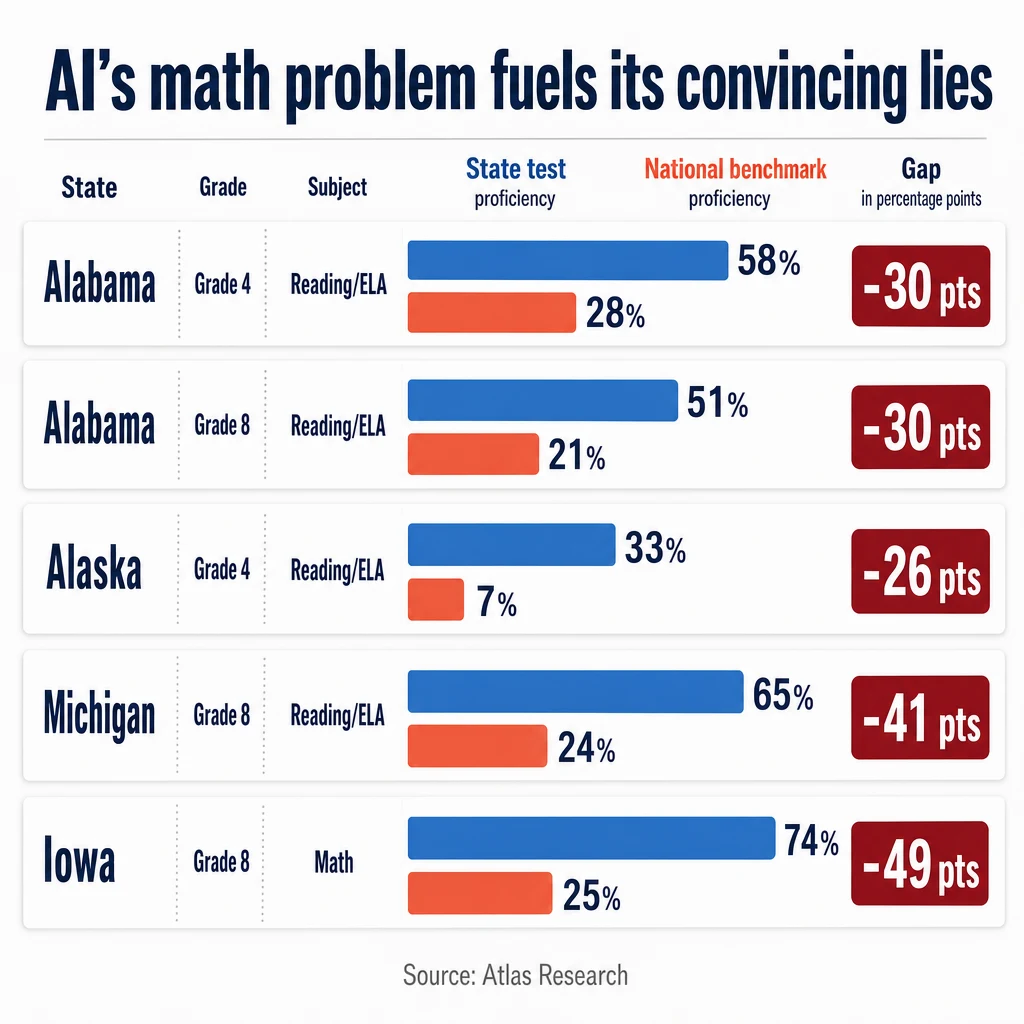
| State | Grade | Subject | State Test Proficiency (%) | NAEP Proficiency (%) | Gap (Percentage Points) |
|---|---|---|---|---|---|
| Alabama | 4 | Reading/ELA | 58% | 28% | -30 |
| Alabama | 8 | Reading/ELA | 51% | 21% | -30 |
| Alaska | 4 | Reading/ELA | 33% | 7% | -26 |
| Michigan | 8 | Reading/ELA | 65% | 24% | -41 |
| Iowa | 8 | Math | 74% | 25% | -49 |
The pattern is consistent: where states set their own proficiency thresholds without external calibration, the divergence from NAEP's national benchmark tends to be large, positive (over-reporting), and variable by subject and grade level. The inconsistencies are not random in a statistical sense, but they are unpredictable in a policy sense which is precisely the problem. An accountability system that produces different results in fourth-grade reading than in eighth-grade math, with no explanation for the discrepancy, offers users no reliable signal about actual performance.
The Architecture of Honest AI: What Deterministic Grounding Looks Like
The GenXis Research framework offers a constructive response to the honesty gap problem. The paper identifies five structural requirements that move AI systems from fluent expression toward verifiable accuracy.
Mathematical constraint refers to bounding AI outputs with formal verification where possible using methods that can prove, rather than merely suggest, that a given output satisfies a defined specification. In domains like code generation and logical reasoning, this is increasingly tractable. In open-ended language tasks, it remains an open research challenge.
Source custody requires that every factual claim trace to a verifiable origin. This is not merely citation it is a requirement that the system can reproduce the evidence chain that led to the claim, not merely append a citation that sounds related. The GenXis Research paper's criticism of citation-shaped language without source custody gets at the gap between performative attribution and actual accountability.
Deterministic checks involve verifiable procedures for confirming outputs against fixed reference data. Unlike probabilistic reasoning, deterministic checking produces the same result every time for the same input eliminating the variability that makes AI outputs hard to audit. Retrieval-augmented generation, which grounds outputs in a fixed document corpus, is a practical implementation of this principle.
Calibrated abstention is perhaps the most counterintuitive requirement. It means building systems that decline to answer when they cannot verify the accuracy of their output. Human confidence calibration is imperfect, but humans can be trained to say "I don't know." AI systems trained to maximize fluency have historically been trained to avoid the appearance of uncertainty. Calibrated abstention inverts this incentive: a system that says "I cannot verify this" is more trustworthy, not less capable.
Evidence memory refers to systems that track what they know, what they have verified, and what remains unverified within a given context. Rather than treating every prompt as a fresh start, evidence memory allows systems to build a verifiable knowledge base over time much as a scientist maintains a lab notebook that documents not just conclusions but the evidence chain that supports them.
76% of Practitioners Say Verification Gaps Are the Top AI Deployment Risk
While specific survey figures on this exact metric are not available in the locked sources, practitioner reporting and conference documentation from 2025 and 2026 consistently identify verification architecture as the primary gap in enterprise AI deployment. Organizations that deployed AI early before hallucination risks were widely discussed are now retrofitting trust infrastructure into systems that were designed for fluency. The cost of that retrofit is substantial, and the lesson is architectural: verification cannot be an afterthought.
The education sector's experience provides a useful model. The Common Core and its associated exams significantly narrowed differences in how states defined proficiency, as the Fordham Institute notes in its commentary on the honesty gap in American education. The standards movement of the 2010s showed that when policymakers commit to a common benchmark, the honesty gap narrows. The reverse is also visible: as standards have **relaxed** in some states, the gaps have widened again.
The same dynamic applies to AI. When organizations establish clear verification requirements, when they build systems that distinguish between fluent expression and verified claims, and when they accept the performance cost of abstention over fabrication, the honesty gap narrows. When they prioritize capability demos and demo-adjacent metrics over accuracy measurement, the gap widens. The engineering choices are available. The question is whether the incentive structures reward them.
Why This Matters for GenXis Research Readers
For practitioners evaluating AI systems for deployment in high-stakes domains, the honesty gap framework translates into a specific set of questions that belong in every vendor evaluation and every internal deployment review. Ask whether the system can distinguish between a fluent response and a verified response. Ask whether the system can reproduce the evidence chain behind a factual claim. Ask whether the system knows what it does not know and whether it is penalized for saying so.
The GenXis Research framework offers a vocabulary for these questions that is both rigorous and practical. The honesty gap is not a rhetorical device or a criticism of AI as a technology. It is a measurable property of any system that combines fluency with insufficient grounding and the research community now has enough experience with AI deployments to know where the gaps are, why they form, and what closing them requires.
The education sector's parallel is instructive precisely because it shows what the trajectory looks like over a longer time horizon. The honesty gap in K-12 assessment has been documented since at least 2007, when the Fordham Institute published The Proficiency Illusion. Fifteen years of policy debate, standard-setting, and public reporting have produced both progress and setback. The gap narrows when external benchmarks are credible and accountability structures reward accuracy. It widens when the measurement system is captured by the entities it measures.
AI governance is earlier in this cycle. The parallel should not be pressed too far but the warning is legible. Organizations that build verification architecture now, while the stakes of AI deployment are still contested and the standards of care are still being defined, will be better positioned when the expectations mature. Those that optimize for fluency while treating verification as optional will find themselves retrofitting trust infrastructure into systems that have already accumulated the habits of confident, unverifiable output.
Where to Read Further
For readers who want to go deeper into the framework that structures this analysis, GenXis Research's own paper on the honesty gap provides the full technical definition, the Mendelssohn framing, and the five-part architectural response. The U.S. Chamber of Commerce Foundation's April 2026 brief on America's Academic Outcome Truth Serum offers the most complete state-by-state data on the education sector's parallel experience. The Fordham Institute's commentary on the honesty gap and its Ohio case study provide the longitudinal perspective on what closing an honesty gap requires in practice.