The Machine That Always Had an Answer
In a conference room in early 2026, a team of legal analysts was testing an AI assistant ahead of a high-stakes contract review. The system returned a memorandum so polished, so clearly structured, so deeply confident in its prose that the lead analyst later admitted she almost stopped reading. It looked right. It read right. It sounded right. Then she checked the citations. Three of the four case references did not exist. The fourth was real but misquoted. The machine had produced a document that felt authoritative while being, in the most technical sense, fabricated. Nobody had asked it to lie. Nobody had programmed it to deceive. It had simply done what it was designed to do: generate language that sounds reasonable.
This incident, or others like it, illustrate what researchers at GenXis Research have begun calling the honesty gap in artificial intelligence the growing distance between what AI systems express with linguistic confidence and what can actually be verified as true. It is not a glitch. It is a structural feature of how large language models work, and understanding it is becoming essential for anyone who relies on AI in professional, scientific, or public-facing roles.
What Is the Honesty Gap in AI?
The concept of an honesty gap is not new to policy research. For more than a decade, education analysts have used the phrase to describe a troubling pattern in American schools: states reporting student proficiency rates that diverge sharply from the results of the National Assessment of Educational Progress, the federally administered benchmark known as the Nation's Report Card. When a state deems 72 percent of its fourth graders proficient in reading but the national assessment finds only 31 percent at that level, a gap opens between the story told and the reality measured. That gap, researchers argued, misled parents, wasted resources, and left students unprepared.
GenXis Research has applied the same analytical frame to artificial intelligence. In a 2026 research paper titled "The Honesty Gap: Words Vs. Math," researchers Daryl Ledyard and Philip Tyler argue that the anxiety surrounding AI is not merely that machines can be wrong. It is that machines can be wrong in fluent, reasonable, socially persuasive language. The danger is not bad prose. It is good prose attached to bad facts.
"The worry is not merely that systems hallucinate. The worry is that hallucinations arrive in the same polished form as true answers. A legal citation can be fabricated in perfect legal prose. A medical explanation can sound clinically plausible while omitting a contraindication. A financial summary can appear authoritative while relying on stale facts."
The paper defines the honesty gap as the distance between persuasive language and verified truth. The root problem, the authors argue, is what they call the squishiness of words: language that can preserve signal, but that can also metabolize error into something that sounds reasonable. Over time, small verbal deviations compound, they write, "like a singer drifting slightly off pitch until the tonal center is lost."
GenXis Research's full analysis of the honesty gap traces this problem from its origins in human psychology motivated reasoning, cognitive dissonance reduction, moral disengagement through its manifestation in AI systems as hallucination, unsupported synthesis, and citation-shaped language without source custody.
Why Do AI Systems Struggle with Honesty?
To understand why AI systems generate confident falsehoods, it helps to understand what language models are actually doing when they produce text. Large language models are, at their core, pattern-matching systems trained on vast corpora of human-written text. They learn the statistical relationships between words, phrases, sentences, and ideas. When prompted, they generate the next token the next word or subword that is most likely to fit the pattern established by the prompt and the training data.
This architecture makes language models extraordinarily good at producing text that sounds like it was written by someone who knows what they are talking about. The cadence of expertise, the structure of logical argument, the confident deployment of domain terminology all of these are learnable patterns. What is not learnable from text alone is the question of whether those patterns correspond to reality.
As Ledyard and Tyler put it in their GenXis Research paper:
"Natural language is flexible by design. It allows approximation, metaphor, implication, emphasis, ambiguity, and context dependence. Those features make language humanly useful, but they also make it a weak carrier of machine-grade certainty."
The authors introduce a formal definition to sharpen the distinction: a claim, they argue, is not merely a sentence. It is a tuple containing the statement itself, the domain of application, the truth condition, and the evidence requirement. Without those elements, language remains expressive but under-bounded. It may point toward a reality without specifying the procedure by which that reality can be checked.
This is where the analogy to educational assessment becomes instructive. The education policy literature on honesty gaps offers a window into how similar dynamics unfold when humans, not machines, are the ones producing the language.
The Education Analogy: What the Honesty Gap Looks Like in Schools
In February 2025, the Thomas Jefferson Institute for Public Policy published an analysis of Virginia's student performance data that illustrated the honesty gap with striking clarity. According to the 2024 National Assessment of Educational Progress, only 31 percent of Virginia's fourth graders were proficient in reading, and only 40 percent were proficient in math. Yet on Virginia's own Standards of Learning assessment the state test that most parents see the 2024 results showed 73 percent of fourth graders proficient in reading and 72 percent proficient in math.
The discrepancy is not a measurement error. It is a definitional choice. Virginia's "proficient" standard in reading aligns to "below basic" on the national assessment. In other words, students who cannot display even partial mastery of grade-level knowledge and skills are deemed proficient by the state's own measure.
Robert Pondiscio, a senior fellow at the American Enterprise Institute, offered a blunt assessment of what this means in practice: "You will hear that NAEP 'proficient' is too high a bar and not a good proxy for the ability to read with comprehension," he said. "A fair point as far as it goes, but I defy you to find me a single parent comfortable with her child reading at 'below basic' level."
The Thomas Jefferson Institute's analysis of Virginia's standards documents a state that has chosen a definition of proficiency significantly lower than the national benchmark. The result is a gap between reported performance and actual mastery that parents, policymakers, and employers cannot easily see.
This pattern repeats across multiple states. According to the latest Honesty Gap analysis from the Collaborative for Student Success, Iowa's 2024 state-reported eighth-grade math proficiency rate was 72 percent, while NAEP reported only 27 percent a 45-percentage-point difference. Michigan showed a similarly stark divergence: 65 percent of eighth graders deemed proficient in reading on the state exam, compared to just 24 percent on the national benchmark.
The Collaborative for Student Success, which has tracked the honesty gap since 2014, notes that while the problem has improved over time 23 states had gaps of 30 percentage points or larger in fourth-grade reading in 2014, compared to just four in 2024 the underlying issue remains widespread. Jim Cowen, the organization's executive director, put it plainly: "In many states, the gaps suggest that parents simply aren't getting the full picture of how prepared their kids are for college or the workforce."
Cory Koedel, an economics professor at the University of Missouri-Columbia who has studied educational assessment for more than two decades, argues that grades themselves have become disconnected from actual achievement. Ninety percent of parents believe their children are performing at or above grade level in reading and math, he notes, even though only about one third of fourth- and eighth-grade students in the United States score at a proficient level on NAEP. "We seem to have collectively lost our appetite for bad news," Koedel writes. "Parents don't want to hear that their children are falling behind, and schools are reluctant to deliver that message."
The Parallel in AI: When Confidence Masks Uncertainty
The dynamics observed in educational assessment map directly onto the challenge of AI honesty. In both cases, the problem is not outright fabrication in the sense of deliberate lying. It is something subtler: a systematic disconnect between the confidence expressed in language and the degree to which that language reflects verified reality.
In education, this happens when states lower proficiency thresholds to make their performance look better. In AI, it happens when language models produce outputs that are grammatically correct, logically structured, and stylistically confident while being grounded in training data that may be stale, incomplete, fabricated, or simply misapplied to the prompt at hand.
The education literature also identifies a mechanism that illuminates the AI problem: grade inflation. According to analysis from the Thomas B. Fordham Institute, grade inflation "only got worse during the pandemic and has since widened both performance and attendance gaps." When the cost of delivering bad news rises when parents, students, administrators, and policymakers all prefer optimistic narratives the incentive to soften, blur, or redefine the truth grows stronger. The same dynamic operates inside language models, which are trained to produce outputs that humans find satisfying, plausible, and helpful. The training objective is not veracity. It is usefulness, coherence, and fluency.
Dale Chu, writing for the Fordham Institute in February 2025, described the education honesty gap as "no longer just a policy concern it's a glaring failure of accountability." The same could be said of AI. As these systems move into legal drafting, medical triage, scientific writing, and financial analysis, the consequences of confident error grow more serious by the month.
How Does the Honesty Gap Impact Trust in AI?
The impact on trust is immediate and compounding. When users receive a confident, well-organized response from an AI system, they face a cognitive burden that traditional information sources did not impose. A textbook, a journal article, or a government report comes with institutional accountability. Someone wrote it, edited it, and stands behind it. Errors can be traced to a source, challenged, and corrected. The epistemic infrastructure of traditional publishing includes accountability mechanisms peer review, editorial standards, corrections policies that create consequences for inaccuracy.
AI systems operate differently. They generate text without maintaining a connection to the source material that informed that text. They cannot point to a specific passage in a specific document and say, "this sentence was grounded in that sentence." They produce what Ledyard and Tyler call citation-shaped language without source custody.
The result is a peculiar epistemic asymmetry. AI outputs feel like expert testimony, but they lack the evidential chain that makes expert testimony trustworthy. Users must independently verify everything or accept the risk of acting on confident error.
For organizations deploying AI in professional contexts, the honesty gap creates a hidden verification burden. Legal teams using AI for contract review must check every citation. Medical teams using AI for clinical decision support must independently confirm every contraindication. Financial analysts using AI for research summaries must verify every figure. The productivity gains promised by AI adoption are partially offset by the verification overhead that the honesty gap makes necessary.
Hallucination vs. Dishonesty: A Necessary Distinction
One of the most important distinctions in this discussion is between hallucination and dishonesty. These words are often used interchangeably in public discourse about AI, but they describe fundamentally different phenomena.
Dishonesty implies intent. A dishonest actor knows the truth and deliberately obscures or contradicts it. When a state education official inflates proficiency rates to make a district look better, that is a form of dishonesty it involves awareness of the truth and a choice to misrepresent it.
Hallucination, as the term is used in AI research, implies no such intent. A language model that generates a fabricated case citation is not choosing to deceive. It is producing an output that conforms to the statistical patterns it learned during training. The hallucination is a byproduct of a system optimized for fluency rather than accuracy.
This distinction matters for how the problem is addressed. Dishonesty is addressed through accountability, oversight, and incentive structures. Hallucination is addressed through architectural changes to how AI systems process and generate information.
As Ledyard and Tyler frame it:
"The antidote is not less language, but stronger grounding: mathematical constraint, source custody, deterministic checks, calibrated abstention, and evidence memory."
The proposed solution is not to make AI systems less fluent. It is to embed mathematical and evidentiary grounding directly into the systems' architecture so that language output is tethered to verified claims.
Mathematical Grounding: The Antidote to Linguistic Drift
The core argument in the GenXis Research paper is that the honesty gap in AI cannot be closed through better prompting, better fine-tuning, or better user education alone. These are all useful interventions, but they operate at the level of language use rather than at the level of system architecture. The paper argues that mathematical grounding deterministic constraint, formal verification, source custody, and calibrated abstention is the structural fix that language-level interventions cannot provide.
Mathematical grounding means different things in different contexts. In some applications, it means requiring that claims be traceable to specific, verified sources before they are expressed in natural language. In others, it means using formal verification methods to check logical consistency. In others still, it means building systems that can abstain from answering saying "I don't know" or "I cannot verify this" rather than generating a plausible-sounding response that may be false.
The education policy literature offers a parallel illustration. The Common Core and its associated exams, as Fordham Institute analysis notes, "significantly narrowed these differences" in proficiency definitions between states and the national benchmark. The Common Core did not eliminate the honesty gap, but it introduced a common mathematical standard a shared definition of proficiency that made cross-state comparisons more meaningful. The same principle applies to AI: a shared standard for verification, grounded in formal methods rather than linguistic confidence, could narrow the gap between what AI systems say and what they can actually support.
What This Means for GenXis Research Readers
For readers who use AI in professional, academic, or research contexts, the honesty gap is not an abstract concern. It is a practical challenge that affects the reliability of outputs, the efficiency of verification workflows, and the credibility of decisions made on the basis of AI-generated content.
Understanding the structural roots of the honesty gap its origins in the flexibility of language and the optimization objectives of language models helps explain why AI systems behave the way they do. It also clarifies why the solution cannot be purely behavioral. Asking users to be more skeptical, or asking developers to fine-tune for better accuracy, addresses symptoms rather than causes.
The research points toward a more durable fix: building verification infrastructure directly into AI systems, requiring source custody and mathematical constraint as core architectural features rather than optional add-ons. This is the direction that the most promising lines of AI development are beginning to take, and it is the direction that GenXis Research's analysis identifies as essential.
Can AI Be Trained to Be Completely Honest?
Complete honesty, in the sense of perfect accuracy and perfect abstention from speculation, may be an asymptotic goal rather than an achievable endpoint. Language models are trained on data produced by humans, and human knowledge itself is incomplete, contested, and subject to revision. Even a perfectly honest AI would sometimes produce outputs that later turn out to be wrong, simply because the best available evidence at the time of generation was itself incomplete.
What can be achieved, and what the GenXis Research framework points toward, is a systematic reduction in the honesty gap: systems that are better at knowing what they know, better at citing their sources, better at distinguishing verified claims from speculative inference, and better at saying "I don't know" when the evidence is insufficient.
The education literature offers cautious encouragement on this front. The Collaborative for Student Success notes that states have improved over time. In 2014, 23 states had "the biggest honesty gaps" in fourth-grade reading defined as 30 percentage points or larger. By 2024, that number had fallen to four. Massachusetts and Rhode Island have closed their gaps to within five percentage points or less across both grades and subjects. The trend, though incomplete, is in the right direction.
A similar trajectory is conceivable in AI, but it will require sustained attention to verification infrastructure, transparency standards, and accountability mechanisms. It will also require a shift in how AI systems are evaluated: moving beyond metrics that reward fluency and coherence toward metrics that reward calibration, source fidelity, and honest expression of uncertainty.
How Organizations Can Bridge the AI Honesty Gap
For organizations deploying AI, bridging the honesty gap requires a multi-layered approach. First, it requires acknowledging that the gap exists and that it has practical consequences. Second, it requires building verification into workflows rather than treating AI outputs as presumptively reliable. Third, it requires advocating for and where possible, demanding architectural improvements in AI systems that make verification easier and default.
Some practical steps include:
- Source custody requirements: Where AI systems are used to generate claims, require that those claims be traceable to specific, named sources. Avoid using AI outputs that make assertions without citation.
- Calibrated abstention: Favor AI systems that are designed to say "I don't know" or "I cannot verify this" when uncertainty is high. Systems that always produce an answer, even when the answer may be wrong, are more dangerous in high-stakes contexts than systems that occasionally abstain.
- Verification workflows: Build explicit verification checkpoints into AI-assisted workflows. Do not assume that confident prose equals accurate content.
- Architectural advocacy: When evaluating AI tools, prioritize systems that incorporate mathematical grounding, formal verification methods, and transparency about uncertainty. Reward vendors who invest in verification infrastructure.
The U.S. Chamber of Commerce Foundation's analysis of the academic honesty gap emphasizes that "business and community leaders" have a role to play in advocating for rigorous standards and accurate data. The same principle applies to AI: leaders who deploy these systems in consequential contexts have both the ability and the responsibility to push for better verification standards.
The Broader Stakes
The honesty gap in AI is not merely a technical problem. It is a challenge to the epistemological infrastructure that underpins professional knowledge work. For centuries, human institutions have developed mechanisms for establishing and verifying truth: peer review, editorial oversight, legal standards of evidence, mathematical proof. These mechanisms are not perfect, but they create accountability and enable trust.
AI systems, in their current form, bypass many of these mechanisms. They produce outputs that feel authoritative without the underlying evidential chain. They generate language that is confident without being grounded. And they do so at a scale and speed that makes traditional verification impractical.
The GenXis Research framework offers a way forward: treat verification as a core architectural feature rather than an afterthought, embed mathematical constraint into AI systems so that language output is tethered to formal evidence, and build accountability mechanisms that hold AI systems to the same evidential standards we expect from human experts.
It will not be easy. The flexibility of natural language is a feature, not a bug it is what makes language useful for humans. But that flexibility comes at a cost: language can drift, blur, and metastasize error into something that sounds reasonable. Mathematical grounding is not a cure for that tendency, but it is the best available antidote. And in the high-stakes domains where AI is increasingly deployed, an antidote is urgently needed.
Where to Read Further
For readers who want to explore the honesty gap in depth both in education policy and in AI the following sources offer detailed analysis, state-by-state data, and methodological context:
- GenXis Research: The Honesty Gap: Words Vs. Math The foundational framework connecting linguistic flexibility to verification failure in AI systems, with formal definitions and architectural proposals.
- U.S. Chamber of Commerce Foundation: The Honesty Gap America's Academic Outcome Truth Serum A 2026 brief explaining how the honesty gap is calculated using NAEP and state assessment data, with state-by-state breakdowns.
- Collaborative for Student Success: Latest Honesty Gap Analysis The full 2024 analysis tracking the gap between state-reported proficiency and NAEP benchmarks across all states, with trend data going back to 2014.
- Thomas B. Fordham Institute: Mind the Honesty Gap Commentary placing the latest NAEP results in context and tracing the history of the proficiency illusion in American education.
- Show-Me Institute: The Honesty Gap in Education Analysis of grade inflation, the divergence between grades and test scores, and the consequences for parents and students.
Summary Table: The Honesty Gap Across Domains
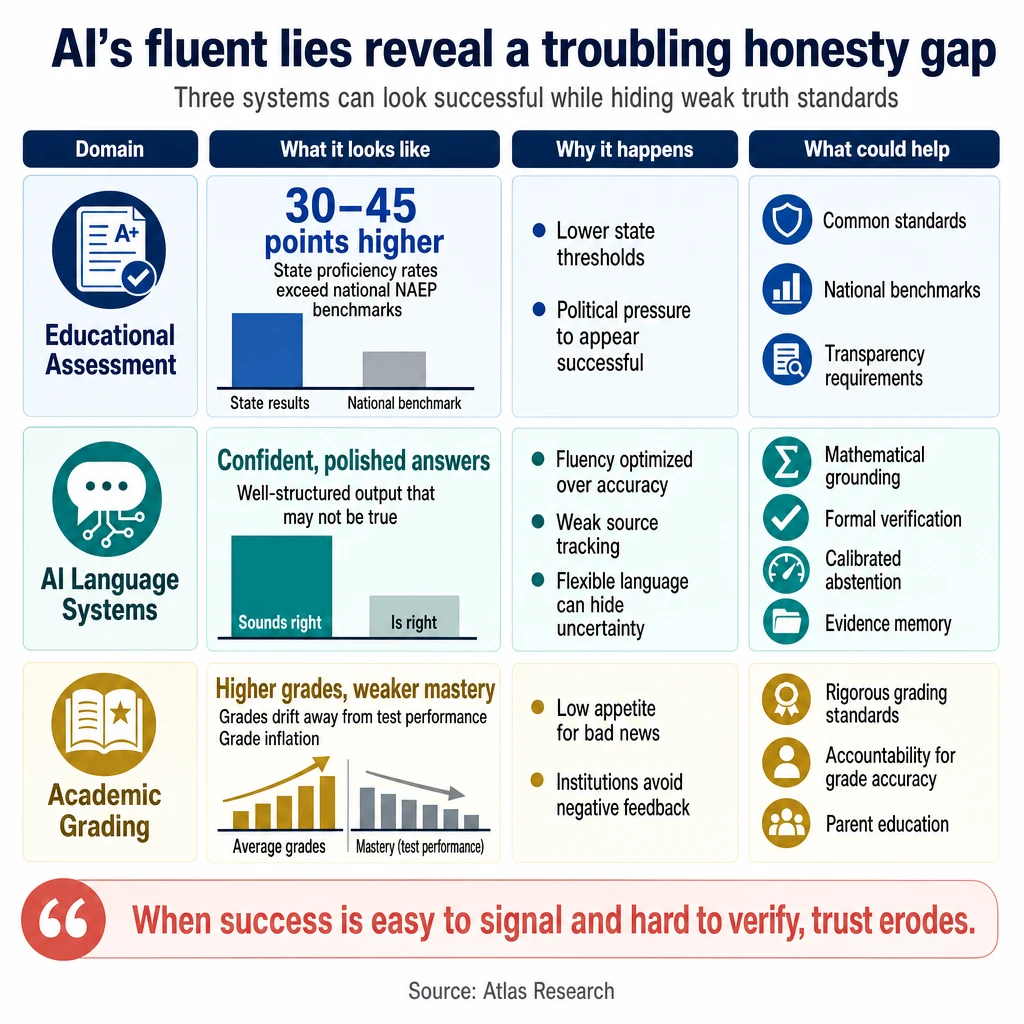
| Domain | Manifestation | Cause | Proposed Antidote |
|---|---|---|---|
| Educational Assessment | State proficiency rates exceed NAEP benchmarks by 30-45 percentage points | Lowered state thresholds; political pressure to appear successful | Common standards; national benchmarks; transparency requirements |
| AI Language Systems | Confident, well-structured outputs that are factually unsupported | Optimization for fluency over accuracy; lack of source custody; language flexibility | Mathematical grounding; formal verification; calibrated abstention; evidence memory |
| Academic Grading | Grades disconnected from standardized test performance; rampant grade inflation | Loss of appetite for bad news; institutional reluctance to deliver negative feedback | Rigorous grading standards; accountability for grade accuracy; parent education |